Last month I sat down to reconcile my startup expenses and flinched. Between AI API calls and cloud services, I'd burned through a few hundred dollars. I'm a solo founder. No funding, no safety net. Every dollar comes out of savings.
The next week, I joined a Startup 101 program run by a Victorian AI company. First session in, they dropped a list of free credits and startup programs. Some of them would have covered nearly everything I'd already paid for.
I sat there doing the mental math on what I could have saved. It stung.
Then I spent a week going deeper. These programs aren't secrets. They're on company websites, government portals, accelerator pages. But nobody strings them together in one place, and most founders I talk to have no idea the entry tiers even exist.
Here's everything I found. The entry tiers mostly just need an ABN, a website that loads, and a real idea. No VC required.
AI model credits
These are the ones that could have saved me the most.
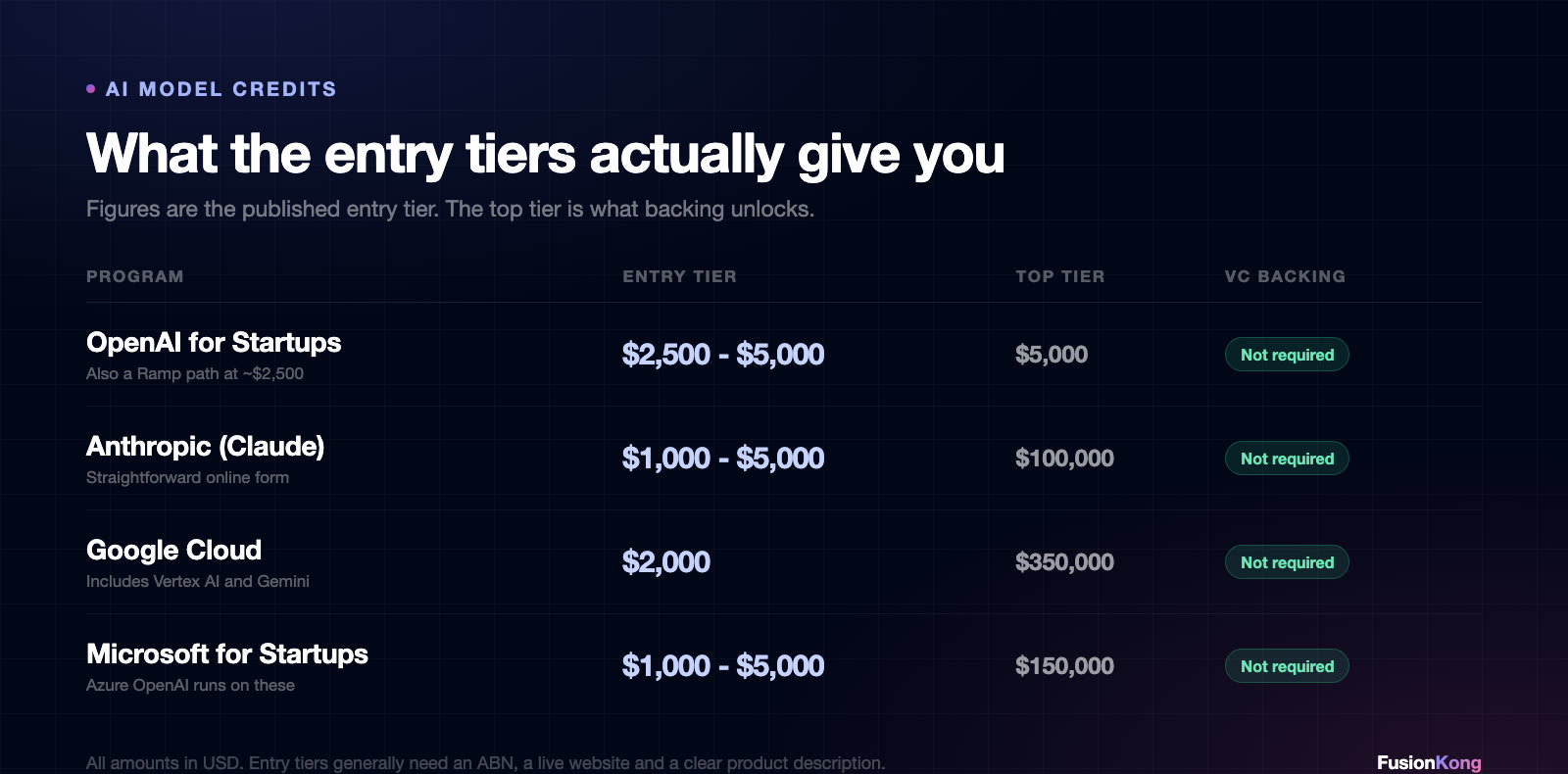
OpenAI for Startups The entry tier lands around $2,500 to $5,000 USD in API credits. Going through an accelerator or VC partner can push it to $5,000. There's also a path through Ramp that unlocks about $2,500. Apply directly on their site - you'll need your company domain and a clear description of what you're building.
Anthropic (Claude) Startups Standard tier is $1,000 to $5,000. If you've raised institutional funding, the top tier goes to $100,000. Straightforward online application - their form asks what you're building and how you'll use Claude.
Google Cloud (includes Vertex AI and Gemini) The early-stage tier at $2,000 is accessible to almost anyone. Seed to Series A startups can reach $200,000, and AI-first startups qualify for up to $350,000. Same application: company details, website, description of your product.
Microsoft for Startups (Azure OpenAI) Entry tier around $1,000 to $5,000, no VC backing needed. Top tier reaches $150,000. OpenAI models run through Azure credits here, so it's the same API access through a different door.
The honest note: the five- and six-figure tiers almost always need VC or accelerator backing. But the entry tiers? A few thousand dollars of free API credits is plenty to build and test an MVP. I burned through $100 in a day when my credits landed just because I could. That feeling - being able to iterate without watching a meter tick - is worth the application form.
Cloud hosting
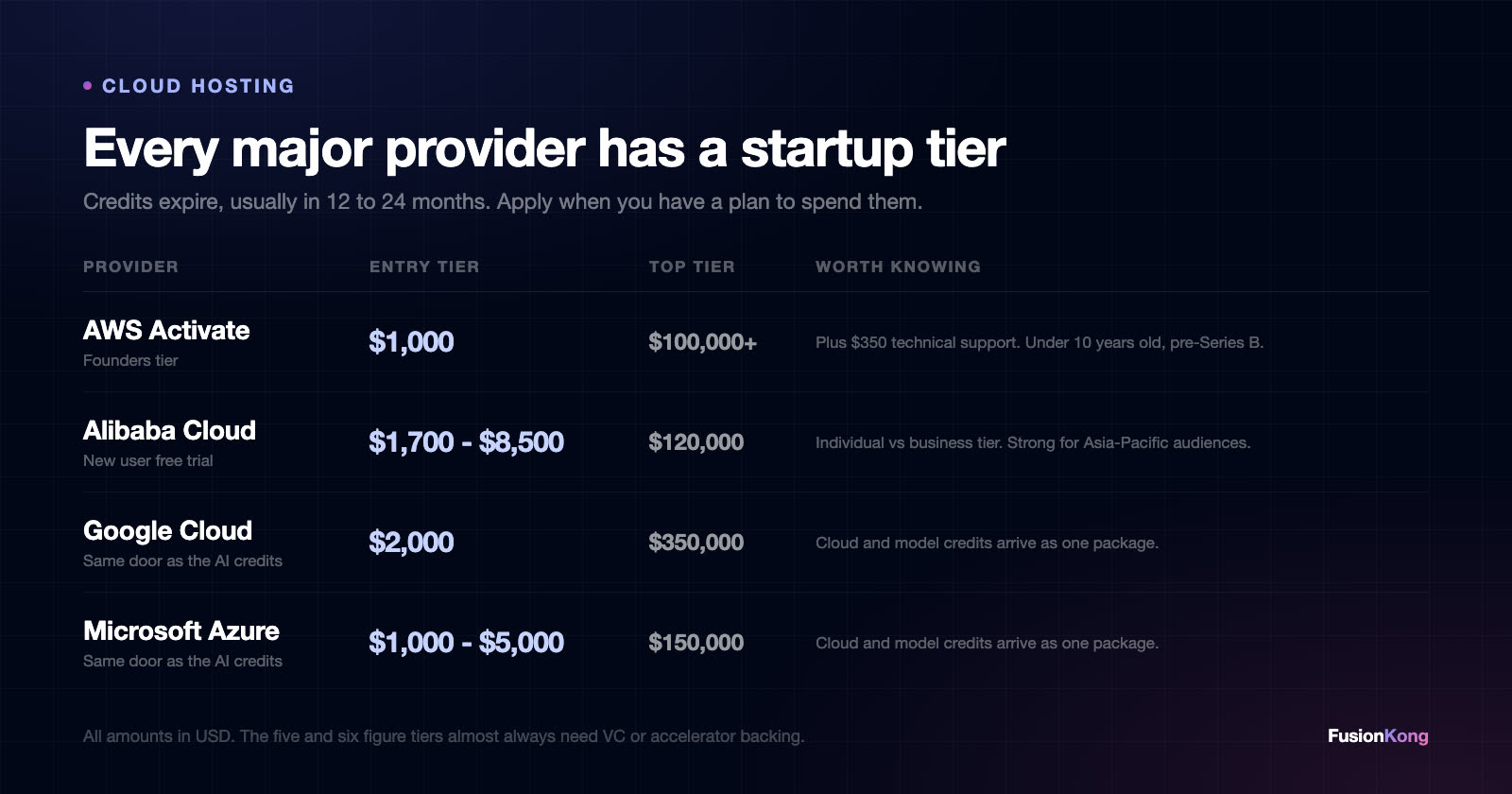
AWS Activate The Founders tier gives you $1,000 in credits plus $350 in technical support. Portfolio tier (VC or accelerator backed) goes to $100,000 and above. Requirements: company under 10 years old, pre-Series B, and a functional website.
Alibaba Cloud New user free trials: roughly $1,700 for individuals, $8,500 for businesses (12-month validity). Their Startup Catalyst program tiers up to a cumulative $120,000. Particularly good if your product has an Asia-Pacific audience.
Google Cloud and Azure These overlap with the AI credits above - cloud and model credits come as one package from both providers.
One thing to watch: credits almost always have an expiry window, usually 12 to 24 months. If you apply, have a plan to use them. Letting credits sit idle and expire is the real waste - not the application time.
SaaS tools
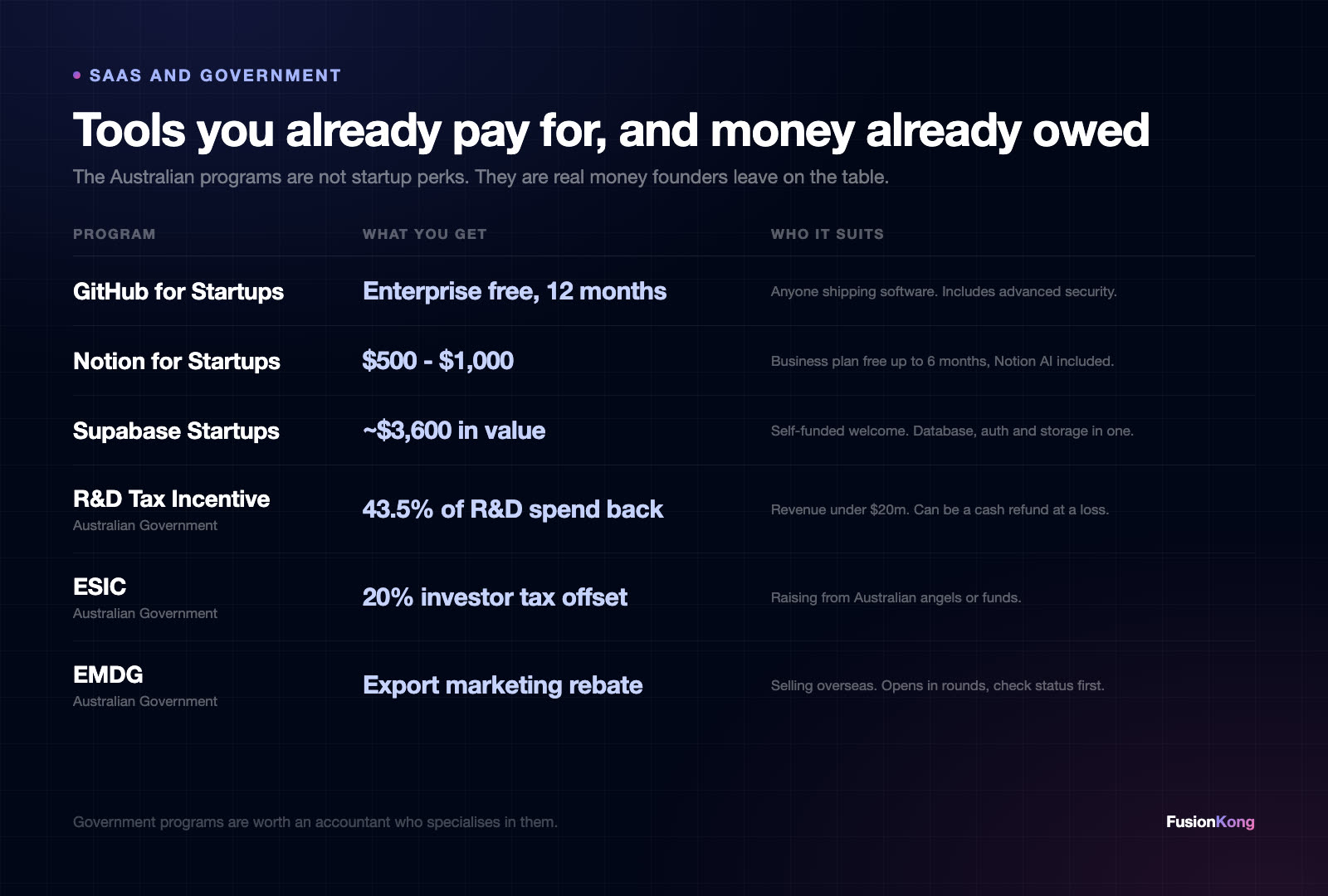
GitHub Qualifying startups can get GitHub Enterprise free for 12 months, including advanced security features. If you're building software, this alone saves hundreds.
Notion for Startups $500 in credits direct, or $1,000 through partner programs. The Business plan is free for up to 6 months, Notion AI included. I use Notion daily for CRM, notes, and planning - this one paid for itself immediately.
Supabase Startups Team plan free for up to 6 months, roughly $3,600 in value. Self-funded startups can apply, no VC recommendation needed. If you need a database, auth, and storage, this covers the stack.
Australian government programs
These aren't startup perks in the traditional sense, but they're real money that Australian founders regularly leave on the table.
R&D Tax Incentive If your revenue is under $20 million and you're doing eligible R&D, you can get 43.5% of your R&D spend back. Even if you're running at a loss, the offset can come back as a cash refund. The application is real work - you'll want an accountant who specialises in this - but for software startups doing genuine development, it's one of the most valuable programs available.
ESIC (Early Stage Innovation Company) Not money for you directly, but it makes your company more attractive to investors. Qualified investors get a 20% tax offset on their investment, plus capital gains tax exemptions. If you're raising from Australian angels or funds, being ESIC-eligible matters.
EMDG (Export Market Development Grant) Reimburses a portion of your overseas marketing and promotion costs. If you're selling software or services internationally, this can cover part of your ad spend, trade shows, and market research. It opens in rounds, so check the current status before you commit to a campaign.
What you need before applying
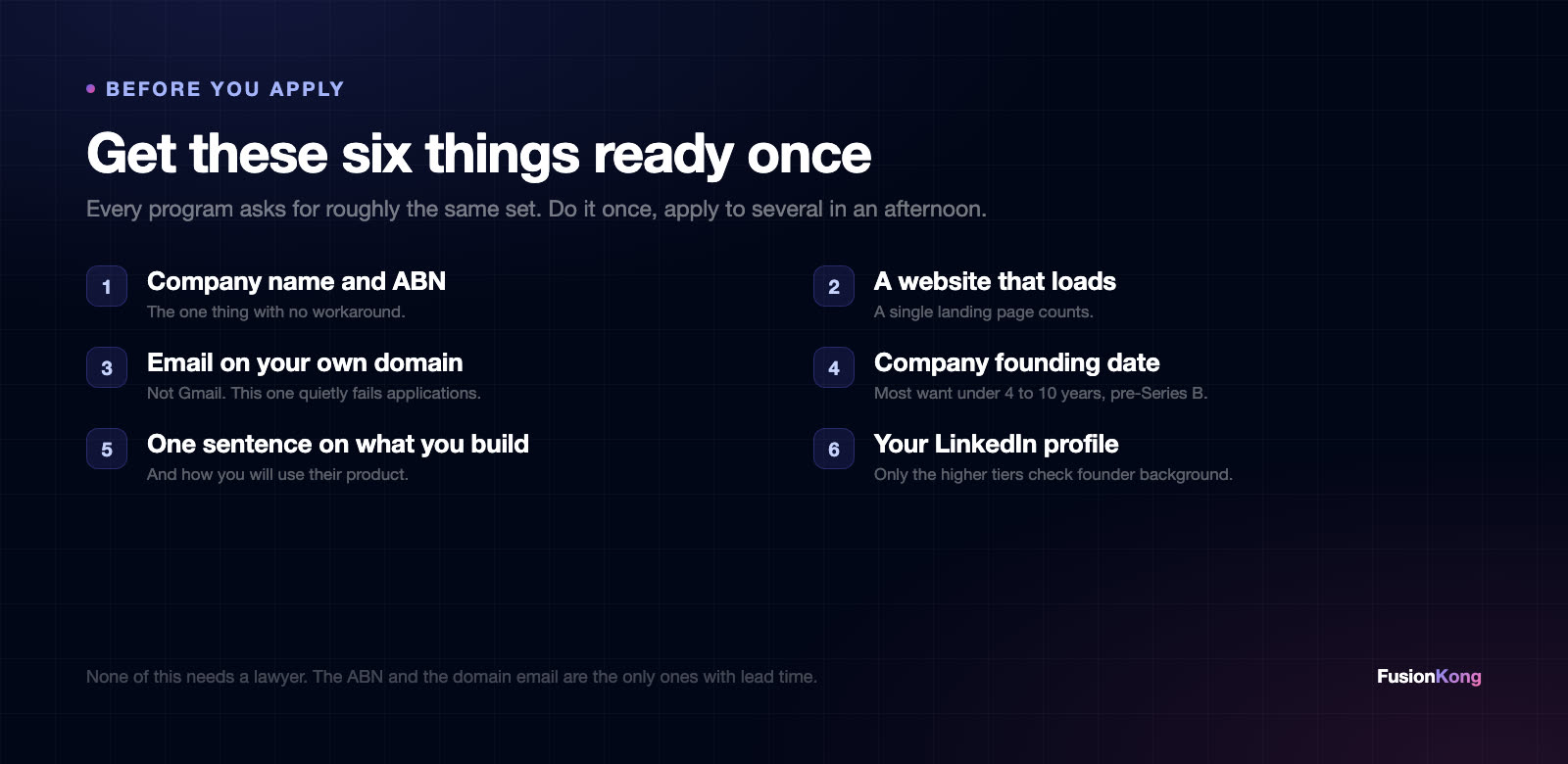
Every program asks for roughly the same set of things. Get these ready once and you can apply to several in an afternoon:
- Company name and ABN
- A company website that actually loads (a single landing page counts)
- A company email address on your own domain (not Gmail)
- Company founding date (most programs want companies under 4 to 10 years old, pre-Series B)
- A clear one-sentence description of what you're building and how you'll use their product
- Your LinkedIn profile (for the higher tiers that check founder background)
Don't hoard credits
This is the part I actually care about.
It's easy to treat this like a coupon hunt and sign up for everything at once. I almost did. But credits have expiry dates, and signing up for services you won't use just creates noise.
Figure out what you're building first. Then go get the credits for that specific thing. A few thousand dollars of free API calls and hosting is more than enough to take a real swing at an MVP. The goal isn't to collect them. It's to build something with them.
Building something and not sure which tools to use? That's exactly the kind of conversation we have with founders - no pitch, just direction.
Book free auditProgram details and amounts current as of July 2026. All figures in AUD unless stated otherwise. Always verify on the provider's official site before applying - programs change, and terms vary by region and eligibility.