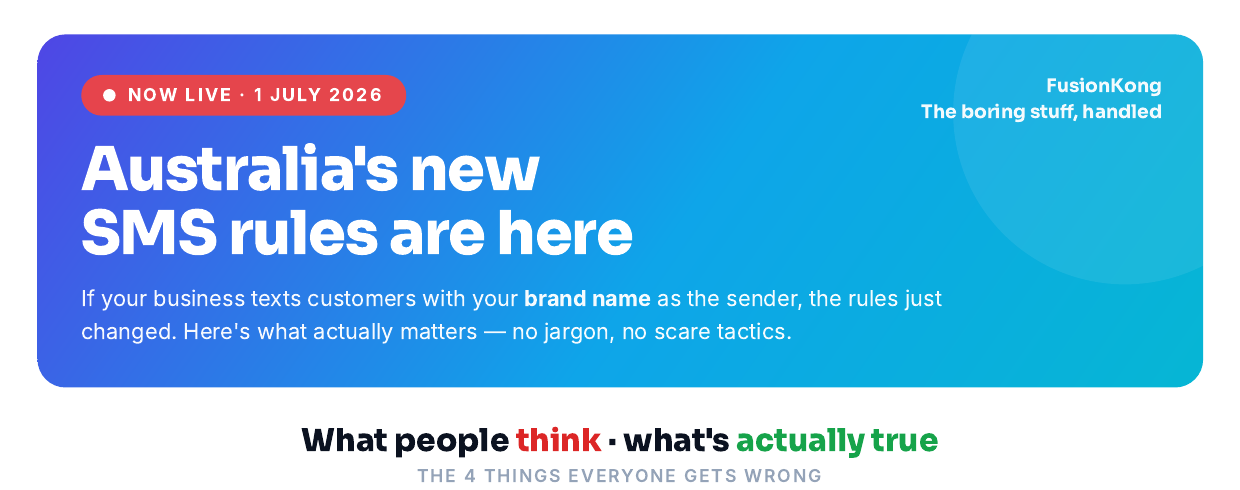
As of 1 July 2026, the rules for sending text messages under your business name in Australia have changed. If you send texts that show a brand name as the sender - "Amazing Plumbing", "FusionKong", your clinic's name - instead of a phone number, this affects you.
There's a lot of scary, half-right information going around (a mate told one of our clients they'd cop a "$300k fine" - that figure isn't accurate for a small business). So here's the plain-English version: what actually changed, what you need to do, and the myths worth ignoring.
What actually changed
Australia's communications regulator, the ACMA, now runs an SMS Sender ID Register. Any branded (alphanumeric) sender ID - a business name in the "from" field - has to be registered.
If it isn't registered, your text gets stamped "Unverified" and grouped in with scam messages. Networks and phones may filter or block it. In plain terms: your quotes, appointment reminders and "sorry we missed your call" texts quietly stop landing - read as spam, or not delivered at all.
It's an anti-scam measure. Scammers have been impersonating brands like Linkt, Australia Post and banks in SMS; tying a brand name to a verified business makes that harder.
Does this apply to you?
Yes, if you send texts with your business name as the sender - quotes, booking confirmations, reminders, payment nudges, missed-call text-backs. It applies to businesses of every size: sole traders, tradies, clinics, agencies.
It does not apply to a plain phone number. An ordinary mobile or virtual number isn't a "branded sender ID", so it doesn't need registering (you just lose the brand recognition that comes with your name at the top).
The "you'll be fined" myth
This is where most of the fear-mongering goes wrong. There are actually two separate rule-sets, and people mash them together:
1. The SMS Sender ID Register (under the Telecommunications Act). These rules bind telcos and messaging providers - not you. The penalties (up to around $250,000 per breach for a company) fall on the carriers who mishandle sender IDs. For your business, the consequence of not registering isn't a fine - it's the "Unverified" label and blocked messages.
2. The Spam Act 2003. This is the one that fines businesses - and it always has. It applies to marketing messages and requires three things: consent, clear sender identification, and a working unsubscribe. Penalties scale with volume and are real (Commonwealth Bank paid $7.5 million for spam breaches in 2024). Exact figures depend on the current penalty-unit value, so confirm specifics with ACMA - but the point stands: the big business fines live in the Spam Act, not the Sender ID Register.
So the honest takeaway is: register your sender ID and run your texts the compliant way. Both, not one.
Not sure which of your texts are affected? That's exactly what our free 30-minute audit is for.
Book free auditHow to register your sender ID (and how long it takes)
You don't register directly with a giant government portal. You go through whoever sends your branded texts - your telco or your SMS/messaging provider (or your booking system / CRM if they send on your behalf). They submit it to the register for you.
A few practical notes:
- Make sure your ABN details in the ABR (authorised contact / service-of-notice email) are up to date - registration verifies against them.
- Your provider must be an ACMA-approved participant. If they're not, your branded texts get blocked regardless.
- Timing: ACMA's own FAQ says most applications are approved within 24 hours, and typically within a few business days. Allow up to a couple of weeks only if extra review is needed. Don't leave it, but it's usually quick.
If you use a third-party tool to text customers (a booking system, a CRM, a marketing platform), ask them directly: "Is our sender name registered with ACMA?" Responsibility is often unclear, and "we assumed the provider handled it" is exactly how businesses get caught out.
The gotcha nobody mentions: branded senders are one-way
Here's the catch that trips people up. A branded sender ID is one-way - customers can't reply to it. So the classic "Reply STOP to unsubscribe" physically doesn't work when your texts come from "YourBrand".
If you send anything marketing-flavoured, your opt-out has to be either:
- a link ("Opt out: yourbusiness.com.au/stop"), or
- a separate number to text ("Text STOP to 04XX XXX XXX") - the pattern big brands like Bupa use.
Same logic applies to letting customers accept a quote or book a time: on a branded sender, that's a link, not a reply.
Do you even need an opt-out?
Not always - and this is a genuinely useful nuance. Under the Spam Act, a message that is purely factual and identifies the sender is a "designated commercial electronic message" - and those are exempt from the consent and unsubscribe requirements.
- A quote the customer requested, or an appointment reminder = factual → no opt-out required (you still have to identify yourself).
- A marketing nudge - "still keen? we're booking up fast, want me to lock you in?" - has a promotional purpose → needs consent + a working opt-out.
The line matters: if any part of a message is promotional, the whole message counts as marketing. Keep transactional texts factual, and treat anything with a sell in it as marketing.
Branded name vs a plain number
A branded sender ID (e.g. "FusionKong"):
- Shows your business name
- Is one-way - customers can't reply to it
- Needs ACMA registration
- Best for quotes, reminders and notifications
A plain mobile or virtual number:
- Shows a phone number
- Is two-way - customers can reply, so "reply STOP" works
- Needs no registration
- Best for conversations and support
Plenty of businesses use both: a branded name for outbound alerts, and a normal number for two-way conversations and easy opt-outs.
What to do this week
- Check whether you send "branded" texts (your name shows as the sender, not a number).
- Ask your provider / booking system / CRM: "Is our sender ID registered with ACMA, and are you an approved participant?"
- Register the sender ID if it isn't - usually just days.
- For marketing texts, add a real opt-out (a link, or "text STOP to a number") and only send with consent.
- Keep transactional texts (quotes, reminders) factual - they're exempt, but must still name you.
Save or share the one-page summary
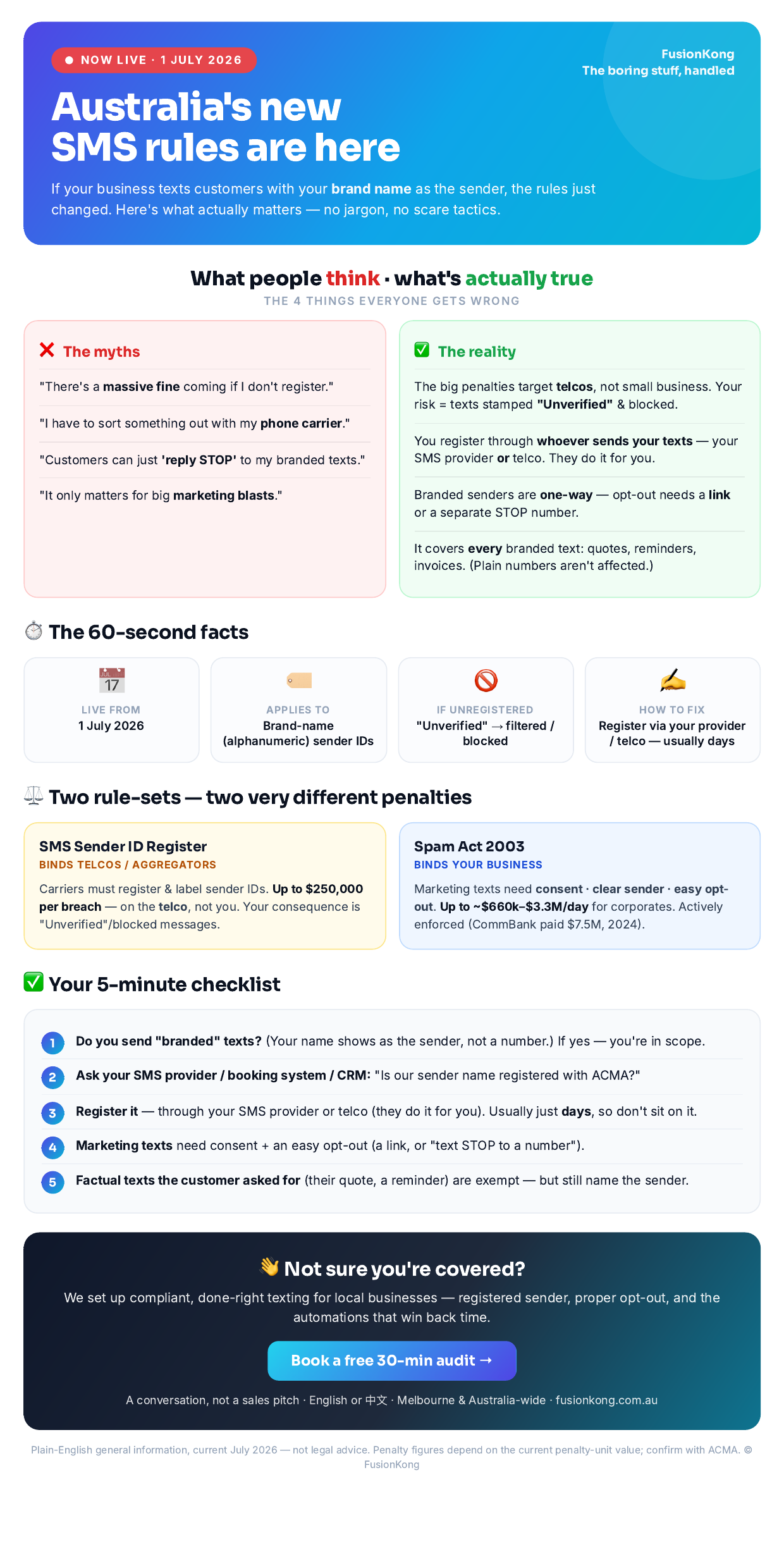
We put all of the above onto a single page - the myths vs the reality, the 60-second facts, the two rule-sets and their very different penalties, and a 5-minute compliance checklist. Handy to forward to your team, your SMS provider, or your bookkeeper.
None of this has to be a headache. The texting that wins back your time - missed-call text-backs, quote follow-ups, reminders, payment nudges - is worth setting up and worth getting compliant. Do it once, properly, and it just runs.
That's the boring stuff we handle for local businesses across Melbourne and Australia-wide (in English or Chinese). If you send branded texts and aren't sure you're covered, the first step is a conversation - not a sales pitch.
Want this set up for your business?
Book free auditGeneral information current as of July 2026 - not legal advice. Penalty figures depend on the current penalty-unit value; confirm specifics with ACMA or a lawyer.